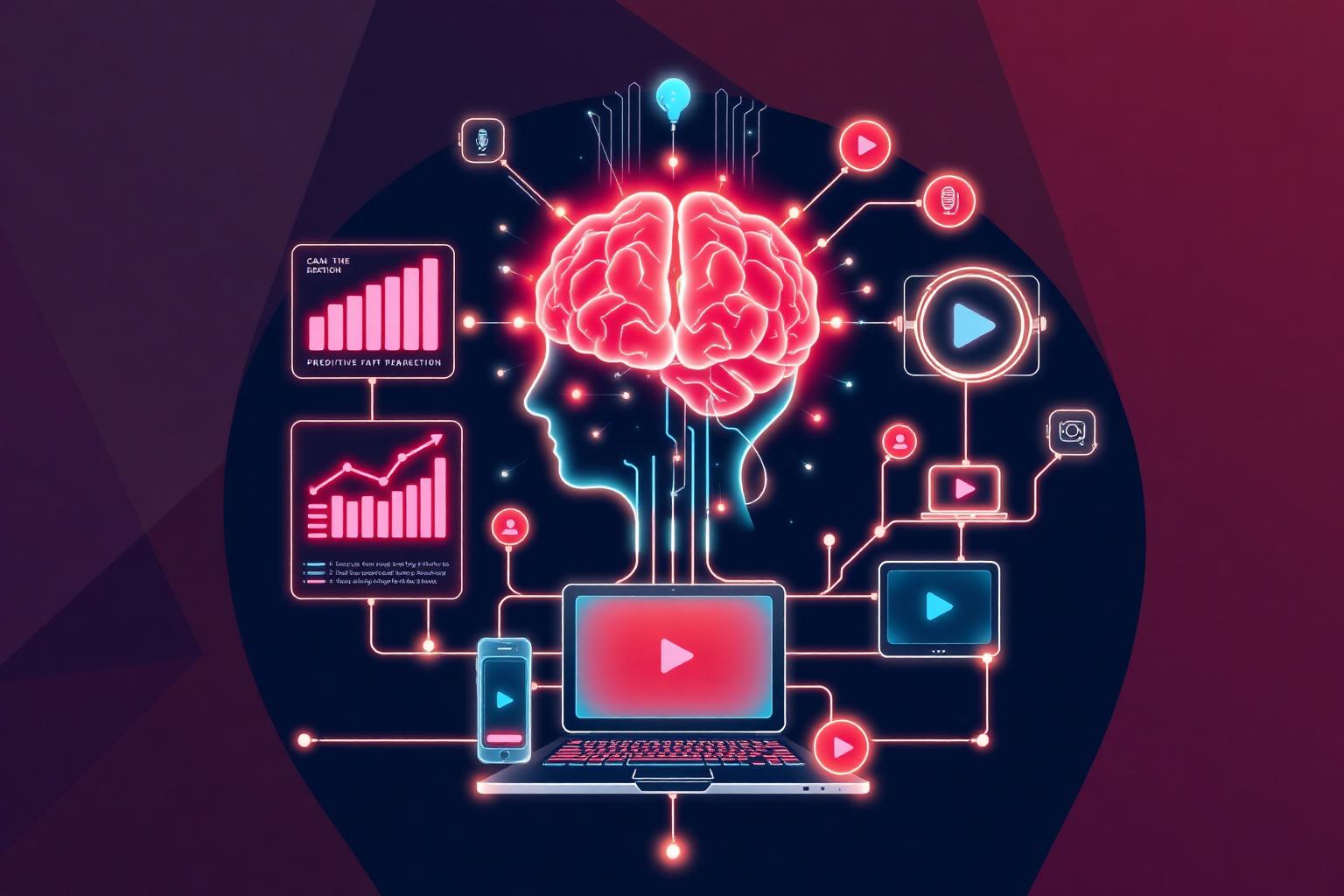
The decade between 2026 and 2030 will compress more change into marketing than the previous twenty years combined. AI is rewriting how content is created and consumed. Privacy laws are dismantling the third-party data economy. Consumers no longer move down funnels — they orbit brands across voice, video, search, social, and physical touchpoints. The winners will not be the loudest brands. They will be the most adaptive.
This is a thought-leadership map of the ten trends that will determine which businesses grow — and which fade quietly — over the next five years. Read it as a strategy brief, not a prediction list. Every trend below is already moving; the question is how fast you reorient around it.
The Future Digital Marketing Landscape
The Future Digital Marketing Landscape
Ten interlocking forces reshape how brands acquire, convert, and retain customers.
1. AI Marketing Becomes the Operating System
By 2030, AI will not be a "tool" inside marketing — it will be the substrate marketing runs on. Forrester forecasts that AI-driven marketing spend will exceed $107 billion globally by 2028. Creative, media buying, personalization, attribution, and customer service will all be agentic by default. The marketer's job shifts from producing to directing intelligent systems.
Example: Coca-Cola's "Create Real Magic" platform let consumers co-create ads with GPT-4 and DALL·E — generating millions of brand assets at near-zero marginal cost. Expect every major brand to run a similar layer within 24 months.
Strategic move: Build an internal AI ops layer now — a prompt library, brand-tuned models, and human-in-the-loop QA. The brands that wait for "AI to mature" will be three years behind.
2. Predictive Analytics Replaces Reporting
Dashboards that tell you what happened are becoming table stakes. The next decade belongs to systems that tell you what will happen — and prescribe what to do about it. Gartner predicts that by 2027, 75% of enterprise marketers will use predictive models for channel allocation, churn prevention, and creative selection.
Example: Netflix's recommendation engine is, at its core, a predictive marketing system. It saves the company over $1B per year in reduced churn. Every SaaS, retailer, and services brand will need its own equivalent.
3. Personalization Goes from Segment to Individual
"Dear [FIRST_NAME]" personalization is dead. The bar in 2026 is real 1:1 experiences — homepages, product feeds, emails, and ads dynamically assembled per visitor in real time. McKinsey research shows brands that excel at personalization generate 40% more revenue than average peers from those activities.
Strategic move: Centralize customer data in a CDP, define real-time triggers, and start with the highest-leverage moments: homepage hero, product recommendations, post-purchase flows.
4. Voice and Conversational Search
Over 50% of all searches are expected to be voice or conversational by 2026. The rise of AI assistants (Siri, Alexa, Gemini, ChatGPT voice) means consumers increasingly ask full questions, not keywords. This rewrites SEO at a structural level — entity-rich, FAQ-style content built around natural language wins.
Example: Domino's voice ordering through Alexa and Google Assistant accounts for a measurable slice of digital revenue and removed friction from one of the highest-frequency purchase moments online.
5. Video Dominance: The Default Content Format
By 2027, Cisco projects that 82% of all internet traffic will be video. Short-form (TikTok, Reels, Shorts) drives discovery; long-form (YouTube, podcasts) drives trust; live video drives conversion. Text-only brands will look like print ads in a streaming world.
Strategic move: Build a "video-first" content engine — one piece of long-form video weekly, atomized into 10–20 short clips, plus a written distillation for SEO. One studio session, ten channels of output.
6. First-Party Data Becomes the Moat
Third-party cookies are gone or going. Apple's ATT and Europe's GDPR/Digital Markets Act make tracking strangers nearly impossible. The brands that win will own direct relationships — email lists, app users, loyalty members, logged-in profiles. Boston Consulting Group estimates first-party data strategies generate 2.9× revenue lift and 1.5× cost savings.
Strategic move: Treat email and account sign-ups as a primary KPI. Build content, tools, and offers that earn the opt-in.
7. Marketing Automation Goes Agentic
The next leap in automation isn't more "if this, then that" — it's autonomous agents that plan, execute, and optimize entire journeys without human intervention. By 2028, expect AI agents that manage paid campaigns end-to-end, write and ship personalized email sequences, and rebalance budget across channels in real time.
8. Conversational Marketing Becomes the Front Door
Forms are dying. Chat, DM, and AI-agent conversations are becoming the primary lead-capture surface. Drift's research found that conversational experiences convert 3–10× better than traditional forms on high-intent pages. By 2027, AI agents on your site will qualify, book, and even close low-ticket deals while sales sleeps.
9. Local Search Evolves into AI-Answered Intent
"Near me" searches keep growing, but the surface is shifting. Google's AI Overviews, Maps, and Apple Intelligence increasingly answer local queries directly — picking one or two businesses to recommend. Local SEO will be won by brands with the strongest review velocity, schema, and Google Business Profile signals.
10. Omnichannel Becomes the Only Channel
Consumers no longer think in channels — they move fluidly from TikTok to Google to your store to your app to email. Harvard Business Review research shows omnichannel customers spend 10% more online and 4% more in store than single-channel buyers. The brands that knit experiences together win loyalty.
Trend Impact Matrix
Trend Impact Matrix
| Trend | Revenue Impact | Adoption Difficulty | Urgency |
|---|---|---|---|
| AI Marketing | Very High | Medium | Now |
| Predictive Analytics | Very High | High | 12 months |
| Personalization | High | High | Now |
| Voice Search | Medium | Low | 12–24 months |
| Video Dominance | Very High | Medium | Now |
| First-Party Data | Very High | Medium | Now |
| Marketing Automation | High | Medium | Now |
| Conversational Marketing | High | Low | Now |
| Local Search Evolution | High (local biz) | Low | Now |
| Omnichannel Experiences | Very High | High | 12 months |
Adoption Timeline 2026–2030
When Each Trend Becomes Table Stakes
| Year | Becomes Standard | Becomes a Competitive Disadvantage to Lack |
|---|---|---|
| 2026 | AI content workflows, first-party data capture | No AI-assisted creative; no email opt-in strategy |
| 2027 | Predictive segmentation, conversational lead capture | Static segments; form-only lead gen |
| 2028 | Agentic media buying, real-time personalization | Manual bid management; one-size homepages |
| 2029 | Voice-optimized content, AI-answered local SEO | Keyword-only SEO; weak GBP presence |
| 2030 | Fully omnichannel, AI-orchestrated journeys | Channel silos; disconnected CX |
The Modern Marketing Technology Stack
Marketing Technology Stack
The seven layers your stack will need by 2027.
Marketing Technology Comparison
Today's Stack vs the 2028 Stack
| Category | Today (2024–25) | By 2028 |
|---|---|---|
| Analytics | GA4 dashboards, lagging reports | Predictive models + causal attribution |
| Content | Manual writing + design | AI-generated, brand-tuned, human-curated |
| Scheduled batch sends | Real-time, triggered, individually personalized | |
| Ads | Manual bid + creative refresh | Agentic media buying + AI-generated creatives |
| Lead Capture | Static forms | Conversational AI agents qualifying live |
| SEO | Keyword + backlink focus | Entity SEO + AI answer optimization |
| CRM | Contact database | Unified customer intelligence platform |
Growth Roadmap 2026–2030
Growth Roadmap 2026–2030
A staged adoption plan for ambitious brands.
Industry Forecasts
Strategic Recommendations
- Treat AI as infrastructure, not a campaign. Stand up a dedicated AI ops layer with prompts, evaluation, and governance.
- Make first-party data a board-level KPI. Email subscribers, account sign-ups, and consented profiles are the new currency.
- Adopt a video-first content engine. One studio day per week, ten downstream channels.
- Replace forms with conversations on your highest-intent pages — pricing, demo, contact.
- Invest in entity SEO so AI engines cite you, not just rank you.
- Unify customer data in a CDP before you scale personalization — bad data scales badly.
- Build predictive models for churn, LTV, and creative — start with one use case, prove ROI, expand.
- Audit your omnichannel gaps: where does the customer experience break between channels? Fix those first.
Expert Predictions for 2030
"By 2030, the average marketing team will be half its current size and produce ten times the output. The differentiator won't be how many people you have — it will be how well your humans direct AI."
— Senior strategist, ClickQ Media
"The brands that will dominate 2030 are quietly building their first-party data flywheel right now. By the time the rest of the market notices, the gap will be unbridgeable."
— Growth advisor
"Search isn't dying — it's being absorbed into AI assistants. Brands that show up as the cited answer will win. Everyone else will fight over scraps."
— AI SEO lead
Frequently Asked Questions
Which trend should small businesses prioritize first?
First-party data and AI content workflows. Both are cheap, compounding, and become harder to start the longer you wait.
Will AI replace marketers?
It will replace the parts of marketing that are repetitive — copy drafts, basic creative, bid management. Strategy, brand, and judgment are increasingly valuable, not less.
Is SEO still worth investing in?
Yes, but the discipline is changing. Entity SEO and answer-engine optimization matter more than keyword density. Brands that build authority will be cited by AI.
How do I prepare for a cookieless world?
Build a first-party data strategy now: lead magnets, accounts, loyalty programs, and a CDP to unify it all. Don't wait for Chrome's final deprecation.
Do I need a CDP if I'm a small business?
Not necessarily a six-figure enterprise CDP, but you need a unified place where email, website, and ad data come together. Tools like Segment, RudderStack, or even HubSpot can serve.
How much should I invest in video?
Enough to ship one piece of long-form video per week, atomized into shorts. Even a $2K/month commitment compounds dramatically over 12 months.
What about the metaverse and Web3?
Both have real but narrow use cases (gaming, luxury, fandom). For most businesses, the 10 trends in this article will deliver 10× the ROI.
How do I measure ROI on AI marketing?
Track output velocity (assets shipped), cost per asset, and lift in conversions on AI-driven variants. Compare cost-per-acquisition before and after.
What's the biggest mistake brands make adopting these trends?
Treating each as a separate project instead of an integrated strategy. AI without data, automation without journeys, personalization without consent — each fails alone.
How fast should I move?
Faster than feels comfortable. The cost of being two years behind in 2028 will be measured in lost market share, not lost campaigns.
The Bottom Line
The future of marketing isn't a single trend — it's the compounding interaction of all ten. AI without data is noise. Personalization without first-party data is impossible. Omnichannel without automation collapses under its own weight. The brands that will define the next decade are the ones that move on all fronts at once, deliberately and now.
You don't need to do everything in 2026. You need to start everything in 2026. Compounding does the rest.
Build a marketing engine ready for 2030.
Our future-ready marketing programs combine AI workflows, first-party data, personalization, and omnichannel orchestration into one growth engine. Book a strategy call and we'll map a 24-month roadmap tailored to your business.
Book a strategy call